
During a May visit to Gidel Hospital, Dr. Jon Fielder joined clinical rounds and saw severe trauma, tuberculosis complications, heart disease, and the growing capacity of one of the world’s most remote hospitals.
by Dr. Jon Fielder
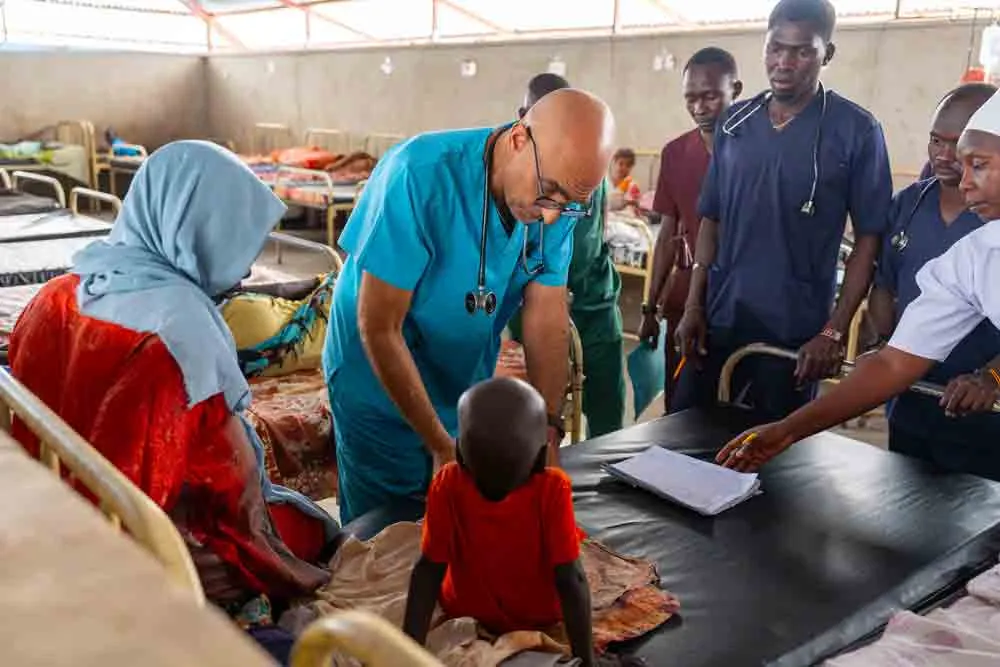
Gidel Hospital, Nuba Mountains, May 2026
A Young Man with Shrapnel
A piece of shrapnel had entered the young man’s pelvis, a thicket of arteries, veins, and nerves where the wise surgeon fears to tread. In advanced settings, enormous amounts of blood products are often needed to replace lost volume and stem the bleeding of deep vessels. “Enormous amounts of blood products” are not available at Gidel Hospital, even though we upgraded the blood bank last year. Using up all the blood on one desperate case means it is not available for more manageable conditions.
A visiting surgeon had advised Dr. Catena not to “explore” the wound. We found the patient “in Trendelenburg” (head down, to maximize blood flow to the brain) in the high-dependency unit (HDU), a service a step below an ICU. His heart rate was 160 beats per minute. The blood pressure was low but holding – for now.
A TB Patient in Crisis
A man in his forties was brought to the main hospital from the TB village, where he had been receiving treatment for tuberculosis in the lungs. Patients live in the TB and leprosy village for six to 12 months to ensure treatment adherence. Travel from the villages is just too difficult, risking defaulting from medication, treatment failure, and the spread of drug resistance. Gidel is the only source of TB drugs in all of Nuba. So the patients live next to the hospital throughout treatment.
His condition had changed suddenly the night before. On rounds, he was gasping, and his pulse could not be felt. The abrupt change in status made me think of a blood clot in the lung (a pulmonary embolism) obstructing the flow of blood from the heart. Sadly, I have seen pulmonary emboli kill many TB patients. Drug interactions make treatment very challenging.
In addition to transferring him to the HDU, I advised blood thinners, antibiotics, intravenous fluids, and oxygen. In a more advanced setting (and in Kenya, where I work), a special CT scan would have been ordered to look for a blood clot. An ultrasound could search for a blood clot in the leg, but Gidel does not have a trained ultrasonographer yet. “Clot-busting” thrombolytic drugs would have been reasonable “empirically” (based on a best guess), but that’s also something the hospital does not have.
The young Nuba medical officer (junior doctor) and clinical officer (physician assistant) intern, a graduate of the hospital’s health training institute, were impressive and summarized the case well.
Miner’s Lung and Tuberculosis
Two patients worked in the gold mines and suffered from diseased lungs, like West Virginia coal miners of the last century in the United States. At least one had tuberculosis on top of the tissue damage, a known complication. A few months ago, a stone mason I saw in Kenya had a similar problem, called “silicosis,” also complicated by tuberculosis. The South African mines are infamous for this deadly complication of miner’s lung and TB.
The TB adds even more damage, a process called “bronchiectasis.” In Malawi, we had a group of 10-15 severe bronchiectasis cases, any one of whom was typically in the hospital at any given time. A cocktail of breathing treatments, antibiotics, steroids, oxygen, and chest physical therapy would usually pull them through an attack.
A Damaged Heart Valve
The visiting surgeon wanted me to listen to a patient with heart failure. We did a better test and placed a mobile ultrasound probe on his chest: rheumatic heart disease, or a damaged heart valve resulting from an untreated throat infection years ago. Surgery was out of the question, of course. AMH helped Tenwek Hospital to build a heart surgery center, but we were a long way from Kenya. Based on the ultrasound, I recommended more aggressive fluid medicine, which could make a real difference in his case.
The Long Work of Wound Care
What really struck me was the number of severe wounds. Most of them were the result of trauma from one cause or another. These deep injuries really require dedicated, knowledgeable hands to manage on a consistent basis. In Malawi, at any one time, I usually had one or two cases I called “projects”: really bad lesions that required cleaning, debridement, dressing, and just careful attention at least three times a week, and sometimes daily. I trained a few nurses to help manage these cases. One patient told us that before coming to Partners in Hope, she had resolved to go home to the village to die. And that wasn’t even one of the more serious wounds.
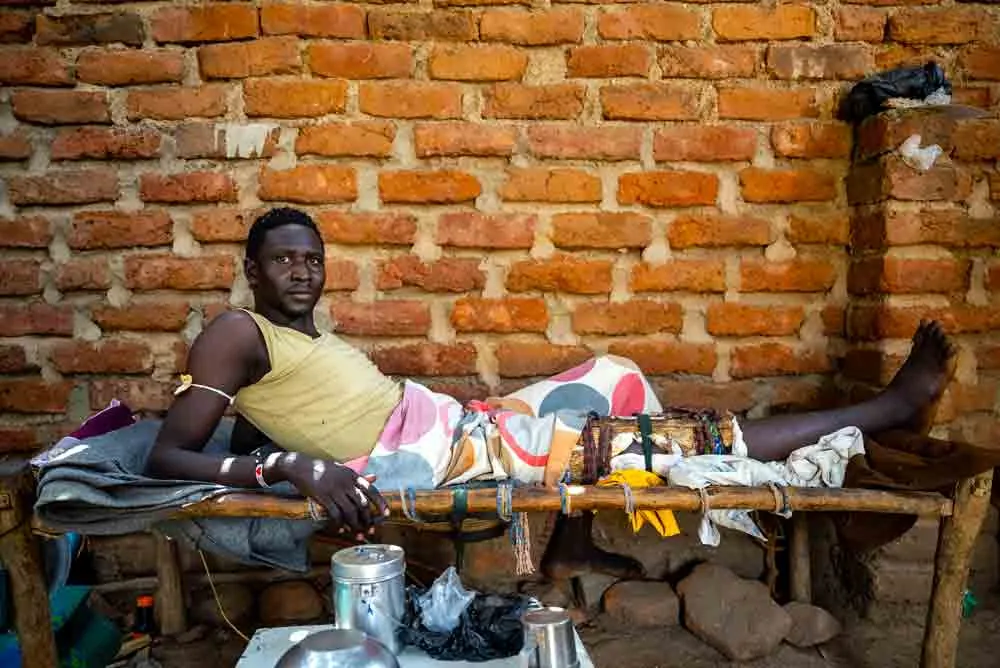
Kijabe Hospital in Kenya, where we have sent several Nuba staff for training, now offers a wound care nurse training program. But Gidel doesn’t really have enough formally trained nurses to let someone go for 18 months. The next health training school class will have 36 nursing students. So, in three years, we can probably afford to send someone for training. That’s a lot of wounds between now and then.
Capacity Is Growing
I rounded for an hour before breaking off to meet with hospital management. We saw more patients than the selection above. Most patients get better and go home, but the volume of suffering is truly overwhelming. There remains much work to be done. Still, anyone who knows the hospital can see the capacity growing year to year.
“There remains much work to be done. Still, anyone who knows the hospital can see the capacity growing year to year.”
Yours in Struggle,
Jon
Enjoy this article? Even getting to Mother of Mercy Teaching Hospital can be an adventure. Read about Jon’s journey to Nuba here.
About the Author
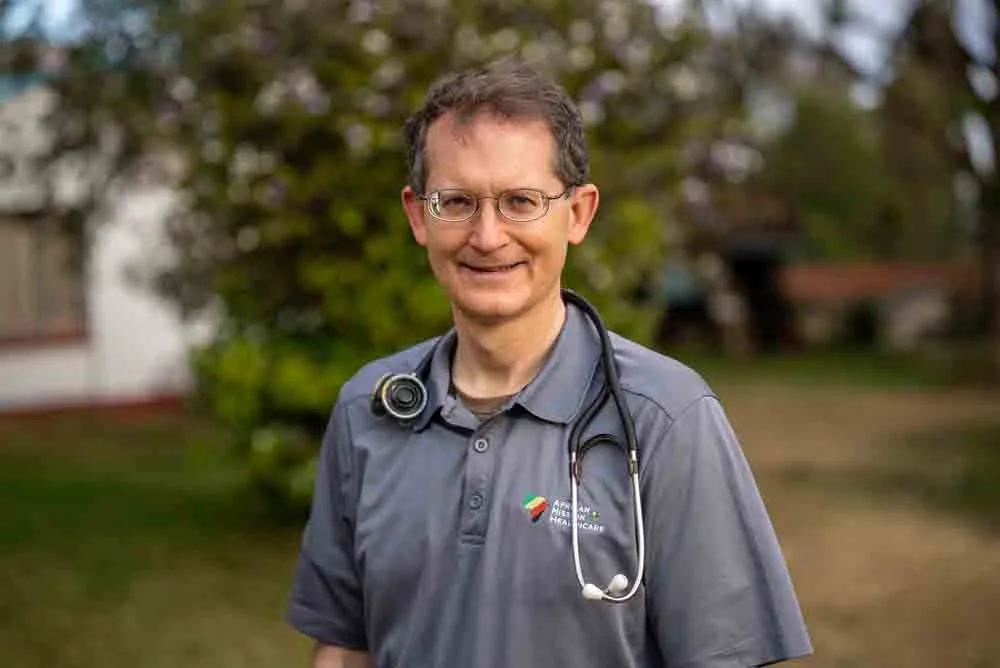
Dr. Jon Fielder is the Co-Founder and Chief Executive Officer of African Mission Healthcare and serves on the Board of Directors of Mother of Mercy Referral Teaching Hospital in the Nuba Mountains of Sudan. He visits the hospital approximately once a year to provide support, attend board meetings, and assist with long-term strategic planning.